The 2026 reform
In 2026 Uzbekistan reformed its Latin alphabet: the 1995 digraphs and apostrophe-letters became single letters.
Has the alphabet changed yet? →
Updated 22 October 2026
Letter changes
The combination ng is no longer listed as a separate letter; it stays in spelling as n + g.
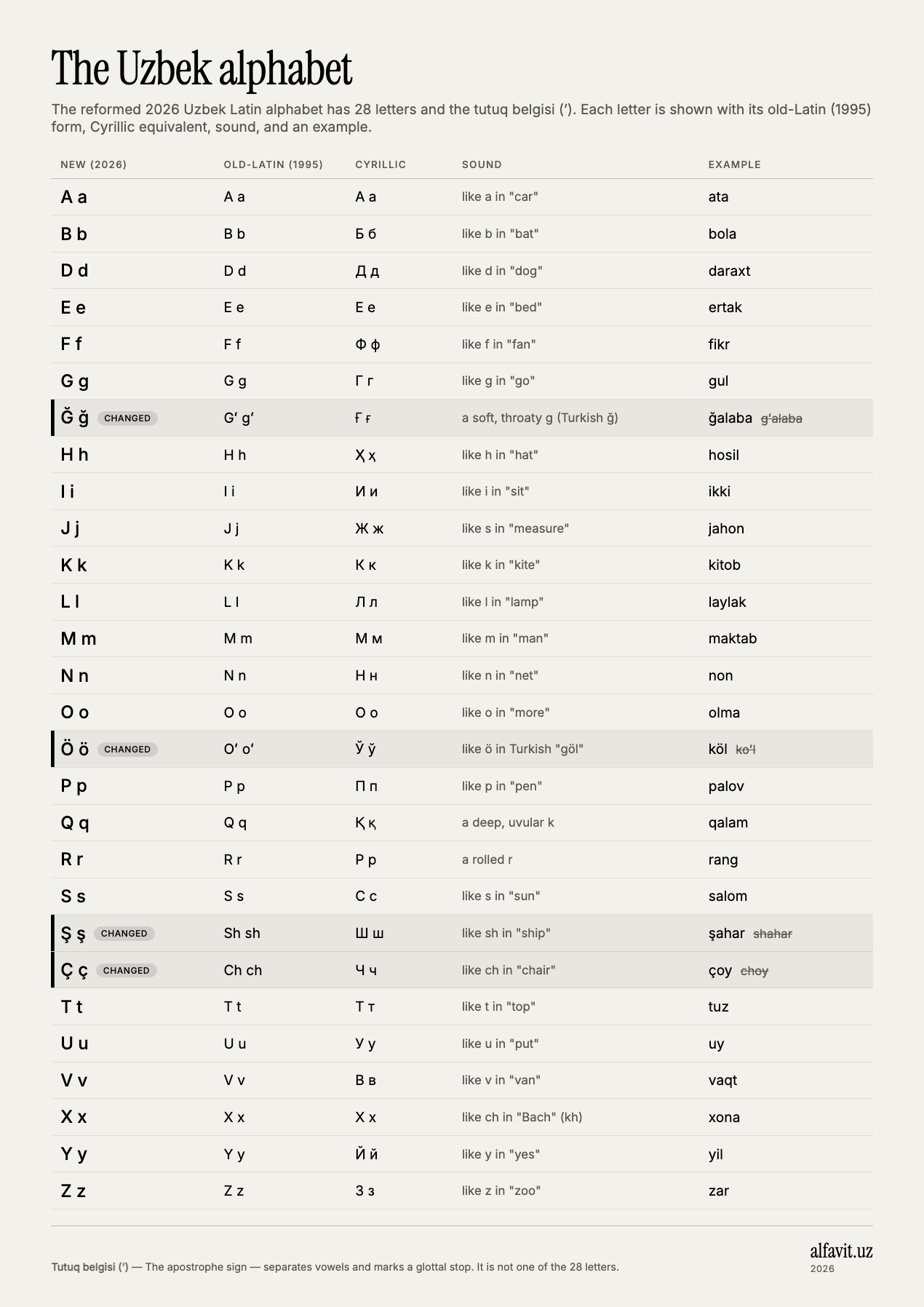
Uzbek alphabet chart (picture and PDF) — download
Letter by letter
sh ş
The digraph sh becomes the single letter ş.
ch ç
The digraph ch becomes the single letter ç.
gʻ ğ
The apostrophe-letter gʻ becomes ğ.
oʻ ö
The apostrophe-letter oʻ becomes ö.
Timeline
- 7 July 2026The Legislative Chamber adopts the law changing the Latin-based Uzbek alphabet.
- 10 September 2026The Senate approves the law and sends it to the President.
- 21 October 2026The President signs the law, on Uzbek Language Day.
- By late December 2026The Cabinet of Ministers approves the programme for putting the law into practice; the law gives it two months.
- 22 April 2027The law enters into force, six months after its official publication.
- After entry into forceMedia, state bodies and official correspondence switch to the new alphabet. Documents issued in the current alphabet stay valid; personal use is free.
- 2027/28 school yearFirst-grade textbooks are printed in the new alphabet.
- 2031All school textbooks are converted.
Adopted by the Legislative Chamber on 7 July 2026, approved by the Senate on 10 September 2026 and signed by the President on 21 October 2026. The alphabet has 28 letters and one apostrophe sign (was 26 letters and 3 letter combinations).
Single letters remove clumsy digraphs and apostrophes — which broke software, URLs, and search — and align Uzbek with other Turkic Latin alphabets.
Frequently asked questions
- What changed in the 2026 Uzbek alphabet reform?
- Uzbekistan replaced the 1995 digraphs and apostrophe-letters with single letters: sh→ş, ch→ç, gʻ→ğ, oʻ→ö; ng is no longer a separate letter. The alphabet now has 28 letters and one apostrophe sign.
- How many letters are in the new alphabet?
- 28 letters and one apostrophe sign (tutuq belgisi). Previously there were 26 letters and 3 letter combinations.
- When was the reform adopted?
- The Legislative Chamber adopted the law on 7 July 2026 and the Senate approved it on 10 September 2026. The President signed it on 21 October 2026.
- When does the new alphabet take effect?
- On 22 April 2027. Law No. LRU-1184 was signed and officially published on 21 October 2026 and enters into force six months after publication. Documents issued in the old alphabet stay valid.
- Which letters changed?
- Four: sh→ş, ch→ç, gʻ→ğ, oʻ→ö. The combination ng is no longer counted as a separate letter.
- Why did the alphabet change?
- The 1995 digraphs and apostrophes broke software, URLs, and search, and made Uzbek inconsistent with other Turkic Latin alphabets. Single letters remove that friction.
- How do I convert Cyrillic or old Latin to the new Latin?
- Use the Alfavit converter — paste your text and it converts instantly, on your device.
- Does Alfavit store or upload my text?
- No. Conversion happens entirely in your browser; nothing is uploaded, stored, or tracked.
- Is Alfavit free?
- Yes — the web converter, the Telegram bot, and the public API are all free.
Guides
Sources
- lex.uz — Law OʻRQ-1184, official text, 21 Oct 2026
- gazeta.uz — in force from 22 April 2027
- gazeta.uz — signed by the President, 21 Oct 2026
- kun.uz — signed by the President, 21 Oct 2026
- gazeta.uz — Senate approval, 10 Sep 2026
- spot.uz — Senate approval, 10 Sep 2026
- daryo.uz — Senate approval, 10 Sep 2026
- zamin.uz — textbook timeline to 2031
- gazeta.uz — law adopted, 7 Jul 2026
- kun.uz — law adopted, 7 Jul 2026
- Wikipedia